
Europe’s Rearmament must put Warfighter First!

Updated: May 18
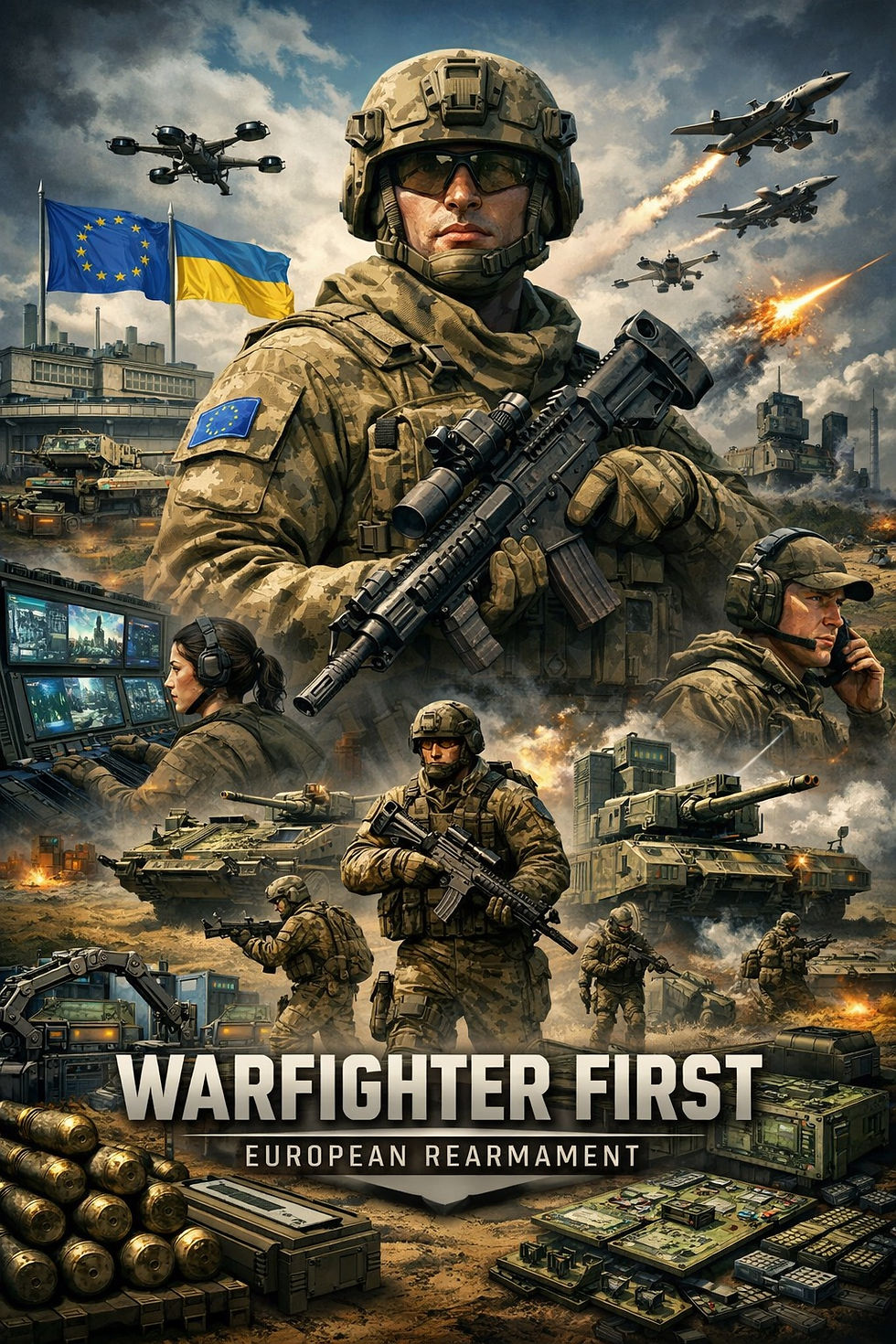
Europe is spending again. Defense budgets are rising, factories are expanding, and the public is talking more seriously about deterrence. But money does not equal combat power. The real issue is cultural: Europe still treats defense procurement like a political exercise instead of a fight for survival. Unless governments recenter rearmament on what the warfighter needs, how fast they need it, and what keeps them alive, this moment of political will risks sliding right back into the slow, fragmented, peacetime habits that created today’s capability gaps.
Operational Requirements Must Drive Procurement
The first shift is straightforward: operational leaders, not political interests, must drive acquisition. Too many ministries of defense still operate around national industrial preferences, bureaucratic choreography, and political optics. The results are predictable: gold plated requirements, bespoke national variants, and systems optimized for domestic politics instead of combat effectiveness. If Europe and NATO are serious about rearmament, operational commands must have decisive voices over what is bought, how it is configured, and how fast it is fielded. The standard is simple: if it does not increase survivability or lethality, it does not get funded. Ukraine lives with this discipline and reality every day. Europe needs to catch up.
Ukraine as an Industry Partner
The second shift is strategic. Europe must treat Ukraine not just as a partner in need, but as a co‑producer and co‑designer of the next generation of European defense capability. No military has more relevant combat experience. No testing ground is more brutally honest. Co‑production with Ukraine—ammunition, drones, electronic warfare (EW), and armored vehicles—would accelerate European output, harden supply chains, and ensure that future systems reflect real battlefield requirements rather than procurement written planning documents. It would also anchor Ukraine inside Europe’s long-term security architecture.
A primary example of this shift is Germany's defense-industrial Zeitenwende, which links a robust defense-industrial base directly to NATO commitments and Ukrainian support. Major industrial actors like Rheinmetall and BAE Systems have already established local entities to support Ukraine's industrial war effort. Germany’s early moves toward deeper co‑production should be the baseline, not the exception.
Startups and the Innovation Fast Lane
The third shift is innovation. Europe’s defense startups are producing some of the most promising technologies in autonomy, sensing, EW, and AI‑enabled targeting. But they face procurement systems built for legacy primes, not rapid experimentation. Europe needs a protected fast lane for innovators: tax incentives, sovereign venture funds, accelerated certification pathways, and pre‑commercial procurement that moves a company from concept to field trial in under a year. The United States, Israel, and Ukraine have already shown that wartime innovation cycles can run in months, not decades. NATO DIANA has opened the door and does a great service in the space; but nations now need national level pathways to capture their own talent and scale it as DIANA has done.
Listen to the Users
The fourth shift is about closing the loop between the user and the engineer. It’s about listening and learning. The most vital data in modern war comes from the platoon commander, the drone operator, and the EW team leader. Their feedback should drive requirement updates every six to twelve months on prototypes. If a system fails in the field, the burden of proof should fall on the program office, not the soldier. Freezing requirements for years, with weak or non-existent feedback loops, is incompatible with the pace of Global
Security environment. Today, the dangerous security environment demands continuous, user driven adaptation. Gaming can help.

This is why I advise Fight Club International. We are leveraging high-fidelity simulations and wargaming to master the complexity of Multi-Domain Operations. Fight Club isn’t just playing gamers; it is an innovation engine. A diverse group of gamers are testing new tactics and technologies in a virtual "school of hard knocks," ensuring that when a concept or system hits the dirt, it has already been refined by the soldiers who will use it. This "double-loop learning" is the only way to stay ahead of an agile adversary. NATO and Europe need to integrate more digital wargaming for the advanced analytics it produces to inform planning and warfare development.
The Bottom Line: The Warfighters
The final shift is philosophical. Europe needs one organizing principle for rearmament: every euro spent must make the warfighter more survivable or more lethal within a defined timeframe. Ukraine applies this standard because it has no alternative. Europe must adopt the same discipline. Programs that do not meet this test should be paused, re‑scoped, or terminated. This is not austerity; it is strategic clarity and building the foundation of lethality to drive force design for modern NATO collective defense.
These cultural reforms must sit atop the structural accelerants already identified by analysts: emergency procurement authorities, multi-year contracts (not decades), industrial surge capacity, raw‑material sovereignty, modernization of legacy systems, and NATO standardization. But without a warfighter-first ethos, these reforms will produce more spending without more capability.
Europe is entering a decisive decade. Deterrence will not be restored by speeches, budget lines, or industrial policy alone. It will be restored when European soldiers, sailors, airmen, and cyber operators receive equipment designed around their survival, delivered at speed, and tested against the realities of modern war. Rearmament is not a political project. It is a moral obligation to those who will fight if deterrence fails.
If Europe embraces that principle, it can rearm fast enough to meet the threat with overwhelming hard power. If it does not, no amount of money will be enough on day zero.
In case you missed it, I had the opportunity to discuss this at The Future of GovCon:
Disclaimer. The views expressed are those of the author and do not reflect the official position of the United States Government, Department of the Army, or Department of War, or that of any organization the author has been affiliated with, including NATO.


Comments